← All work CASE 04 · H-E-B DIGITAL

Starting H-E-B's digital accessibility program.

During COVID-19, customers with disabilities couldn't safely shop in stores — and the digital products that should have been their lifeline were excluding them. No standards, no testing, limited awareness.

Client
H-E-B Digital
Timeline
2019 — 2022
Role
Senior Product Designer → Accessibility Lead
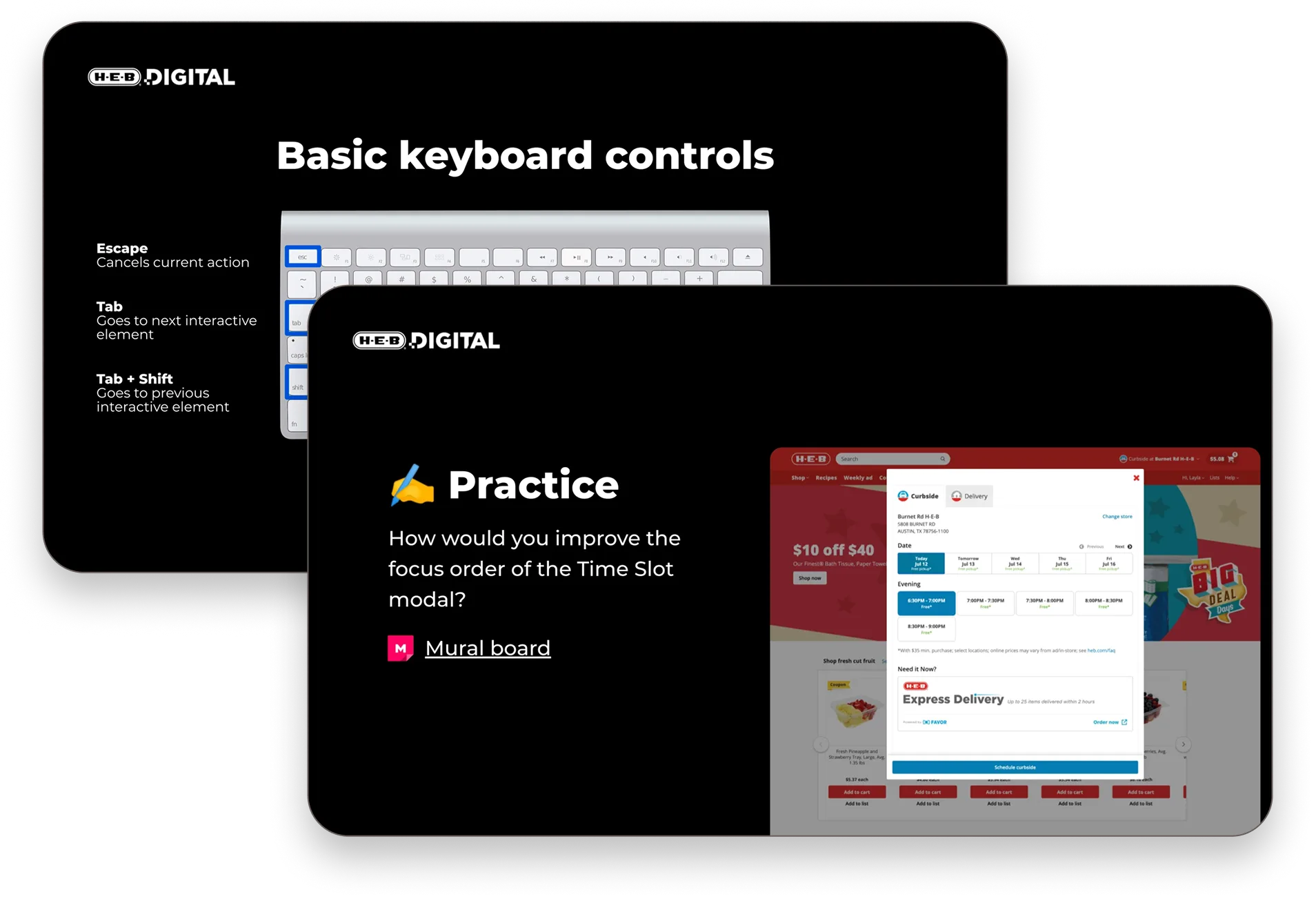
H-E-B accessibility program — workshop slides on focus order and accessibility checklists.

No standards. No testing.

During COVID-19, customers with disabilities couldn’t safely shop in stores. The digital products that should have been their lifeline were excluding them.

There were no accessibility standards. No testing process. Limited awareness across the org of why it mattered. Screen reader users couldn’t complete checkout. Color contrast failed throughout the app. The problems weren’t isolated bugs — they were the absence of a system.
People, not standards.

I piloted user research with Fable, a platform that connects product teams with assistive technology users. We watched a screen reader user try to complete checkout.

That session changed the project. Compliance arguments hadn’t moved the org. Watching a real person hit wall after wall in our flow did. The work stopped being about WCAG line items and became about whether our customers could feed their families.

That reframe — people, not standards — became the spine of everything that followed.

Built in layers.

There was no program to inherit and no budget to start one with. I built the work in layers, each one creating cover for the next.

I led with research, not compliance. The Fable sessions gave designers and engineers a face and a voice to design for, which made people care more than any audit ever did.

I co-founded weekly accessibility office hours with a developer who cared as much as I did. Open to anyone — designers, engineers, PMs, content. No hierarchy, no audit pressure. A safe place to ask questions, learn together, and bring real work to.

I built the case for investment in parallel. Working with the Design System PM and Lead Engineer, I researched vendors and put together a roadmap leadership could actually fund. By the time I left, accessibility was on the strategic plan.

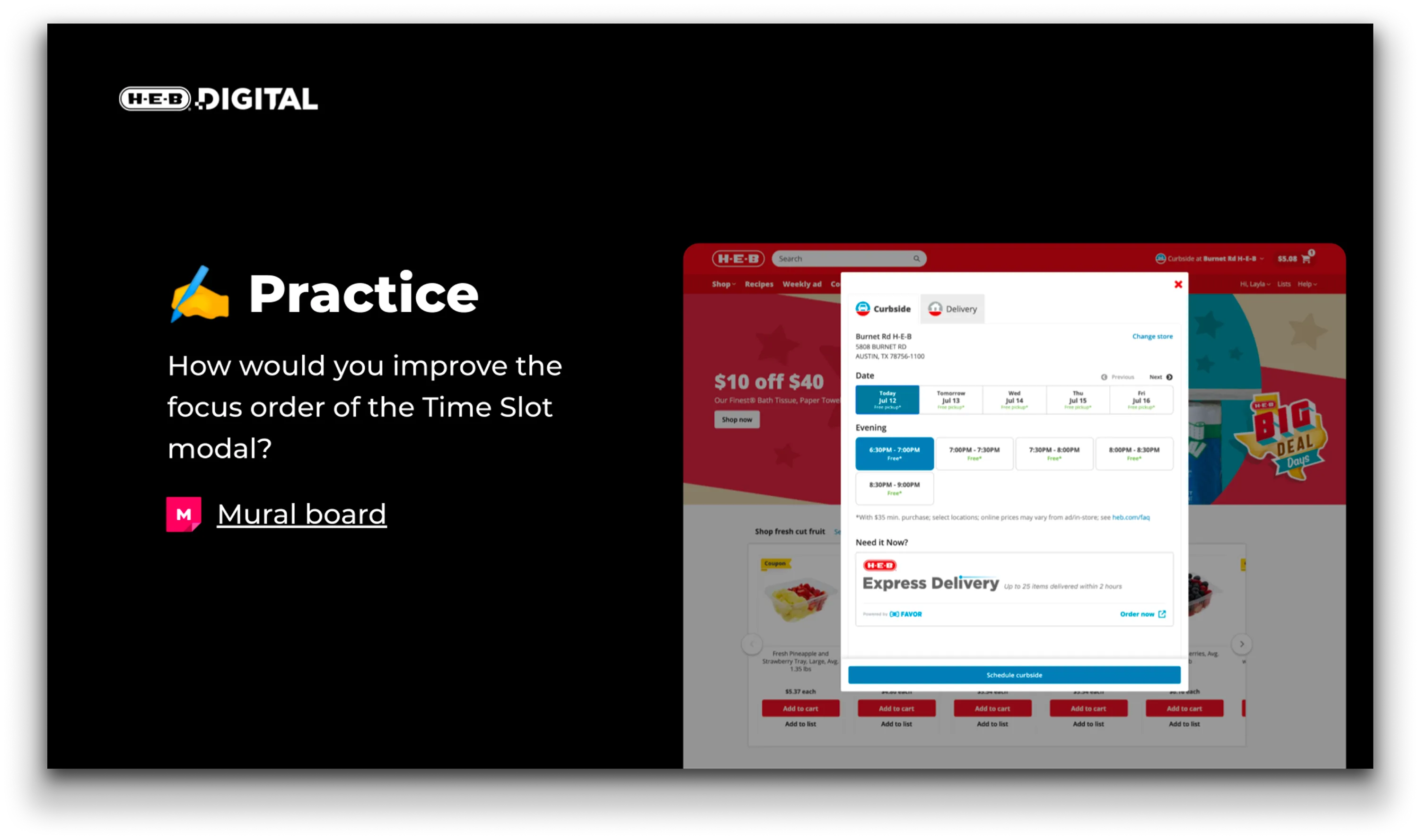
Workshop slide showing HEB.com time slot selection modal with the prompt 'Practice: How would you improve the focus order of the Time Slot modal?' and a link to a Mural board for group discussion.

A focus order workshop. Practicing on a real H-E-B checkout flow made the principle stick.

Accessibility shipped by default, not as an afterthought.

Accessibility became part of how the design system worked. Color contrast, focus states, screen reader patterns — built into components by default, not bolted on at the end. Designers shipped accessible work without having to remember to.

Screen reader users could move through checkout in ways they couldn’t before. The flow wasn’t perfect, but it was meaningfully better — against a baseline where it had been broken.

The cultural shift was the part I’m proudest of. Designers started bringing accessible options to design reviews unprompted. Engineers asked questions in office hours instead of waiting for audits. The change spread because people genuinely cared, not because anyone mandated it.

Office hours outlasted the program I built around them — they became the place the org went with accessibility questions.

A contract with Figma.

The work led to a contract with Figma, where I evaluated their accessibility against competitors with assistive technology users and delivered a prioritized gap analysis with strategy recommendations to their product team.